
Fraud in Federal Programs: Limited Beneficial Ownership Information Available on Awardees
Fast Facts
U.S. companies aren't usually required to disclose the identities of people who benefit from owning them. This lack of transparency may help people fraudulently obtain federal awards like contracts or grants.
For example, in this Q&A, we reported on a scheme where a business owner obscured his identity to participate in a federal program because a felony conviction made him ineligible. We also found:
The federal award process doesn't require business owners to report beneficial ownership information
Federal law requires agencies to collect beneficial ownership information for federal contractors, but the law hasn't been implemented

Puzzle over one hundred dollar bill
Highlights
What GAO Found
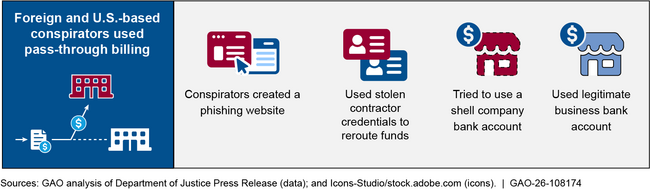
Illicit actors hide their beneficial ownership in multiple ways to fraudulently access federal awards, such as contracts, grants, and Medicare payments, and to evade payment on taxes. GAO’s review of federal cases highlights tactics illicit actors have used, such as using stolen identities, shell companies, professional enablers, and pass-through billing schemes to hide ownership. For example, from July 2019 through January 2023, three purported hospice owners stole identities to register shell companies and defrauded Medicare for nearly $16 million. In another example, from June 2018 through September 2018, a foreign-based scam ring, with U.S. based conspirators, directed legitimate federal contractors to a fake government website. This pass-through billing scam caused the government to misdirect $23.5 million to the fraudsters.
Pass-Through Billing Scam
The federal award process requires recipients to disclose some information on company owners and relationships, but it generally does not require disclosure of beneficial owner information. For example, names of corporate officers and directors may be collected, but these individuals may not be the beneficial owners or exercise substantial control over the entity. Beneficial ownership information is available to a limited extent in data sources such as the Department of the Treasury’s Financial Crimes Enforcement Network’s (FinCEN) company registry, the General Services Administration’s (GSA) System for Award Management, and state incorporation registries. Changes in the scope of reporting requirements now exempt domestic entities from reporting beneficial ownership information in the FinCEN registry. This exemption removed about 99 percent of entities previously required to report.
The National Defense Authorization Act for Fiscal Year 2021 includes a provision for the GSA to maintain a database that contains beneficial ownership information for federal contractors. A Federal Acquisition Regulation (FAR) case was opened in 2021 to implement this and other related provisions, but the FAR Council deadline to draft a proposed rule has been extended until at least September 2026. GSA had considered using FinCEN’s beneficial ownership registry to develop the database, but that source is now of limited use. GAO will continue to monitor progress on GSA’s efforts to implement the statutory provision.
GAO’s analysis of federal award data highlights the hundreds of billions of dollars vulnerable to beneficial ownership-related fraud risks. Awards, such as contracts awarded to foreign businesses, are among those categories that are vulnerable to beneficial ownership fraud risks.
Why GAO Did This Study
Beneficial ownership information identifies the individuals who ultimately benefit or control a company. While individuals listed as company owners in state incorporation records may indeed be the beneficial owner, this is not always the case.
GAO was asked to provide insights on what information is available from various federal, state, and commercial data sources to identify beneficial owners, and the related fraud risks to federal awards.
GAO reviewed relevant fraud cases from various sources such as Department of Justice press releases; reviewed federal regulations on beneficial ownership reporting requirements; analyzed federal award data to assess potential financial impacts of beneficial ownership fraud in federal awards; and examined the nature of company ownership information collected in relevant federal datasets and state corporate registries.
For more information, contact Rebecca Shea at SheaR@gao.gov.